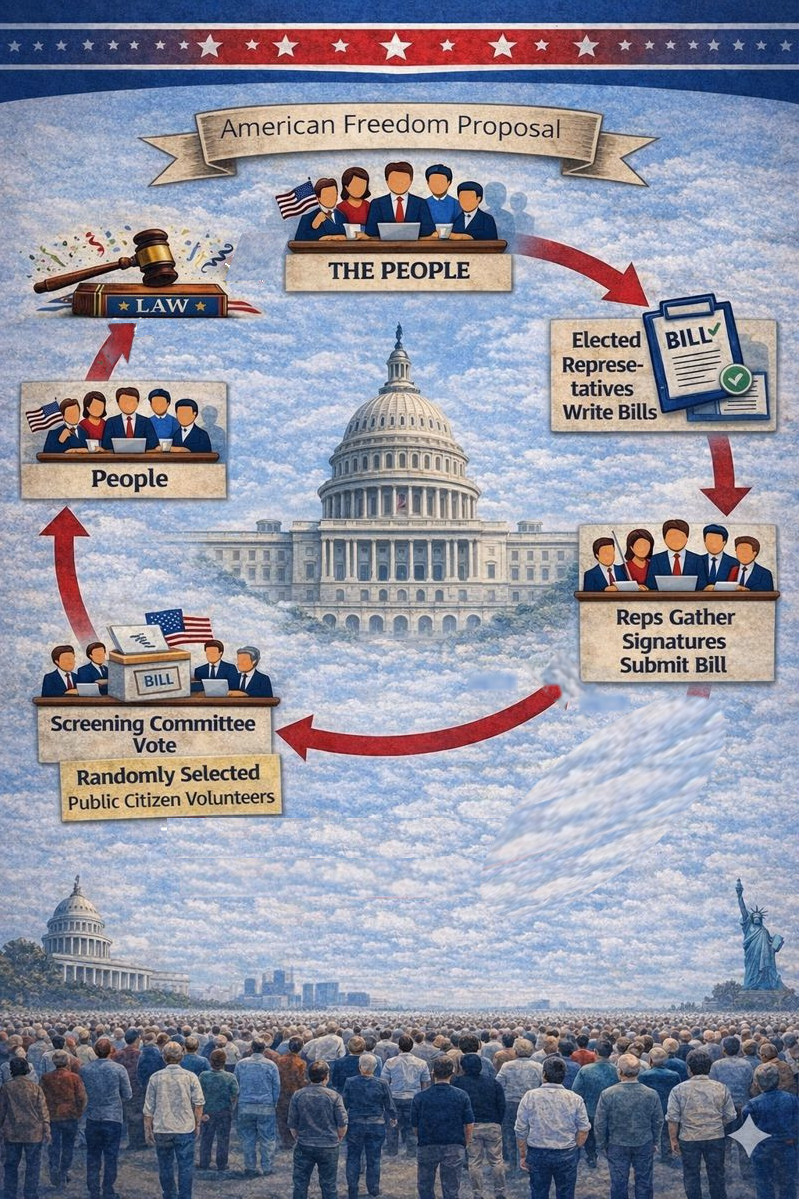
America Freedom Proposal

How it works

Union. Liberty. Clarity.

A Simpler Democracy

The American Freedom Proposal is a set of changes to the constitution that makes it so laws are voted on by the people, not congress.

We swear to keep lawmaking rare, readable, and rooted in public consent.
Citizen Verdict
Short Laws Only
Power Rotates
The Core Idea

Congress drafts. Citizens decide.

Elected officials do not get the final word on laws. The people do. Every proposal must earn real consent, not just a quick vote inside the capitol.

Laws stay short, readable, and limited in number. The system is built to keep power rotating and the public fully in control of the pace.

100,000 Citizen review panel
2/3 Approval to advance
8 Years Total term limit
q-component { id: patriotic-bg } q-component { id: star-field } q-component { id: patriotic-header w3-card,header { style: " border-top: 12px solid #b22234; border-bottom: 12px solid #3c3b6e; background: #fff; padding: 20px 28px; position: relative; text-align: center; " } } q-component { id: civics-process w3-content,div { max-width: 980px; margin: 0 auto; padding: 24px; } } q-component { id: usa-header w3-card,header { style: "border-top:10px solid #b22234; border-bottom:10px solid #3c3b6e;" padding: 20px 22px; } } q-component { id: usa-badge w3-tag,span { style: "background:#3c3b6e; color:#fff; font-weight:700; letter-spacing:.5px;" } } q-component { id: section-card w3-card,section { padding: 18px 18px 14px 18px; margin-top: 16px; } } q-component { id: step-card w3-card,section { padding: 16px 16px 12px 16px; margin-top: 12px; style: "border-left:6px solid #3c3b6e;" slot { name: "title" } slot { name: "body" } slot { name: "meta" } } } q-component { id: eagle-badge w3-tag,div { style: " background: url('https://flagcdn.com/us.svg') no-repeat center/contain; width: 64px; height: 64px; position: absolute; left: 20px; top: 18px; animation: pulse 3s infinite ease-in-out; " } } patriotic-bg { civics-process { usa-header { div { usa-badge { text { CIVIC REFORM — ONE BILL AT A TIME } } h1 { style: "margin:10px 0 6px 0; font-size: 28px; line-height: 1.2;" text { Citizen-Signature Bills + National Review + National Vote } } p { style: "margin:0; opacity:.9;" text { A step-by-step, plain-language process with hard constraints designed to reduce bill spam, keep laws readable, and require broad national support. } } } } section-card { h2 { style:"margin:0 0 10px 0;" text { Core Constraints (Non-Negotiable Rules) } } ul { li { text { Remove the House of Representatives. } } li { text { Keep only the Senate: exactly 2 Senators per state. } } li { text { Each Senator may submit at most 2 bills per year. } } li { text { Bills must be one page and under 2,000 words. } } li { text { Any bill that becomes law does NOT count toward a Senator’s annual total (so productive lawmakers can keep producing). } } li { text { Every bill requires at least 5,000 citizen signatures before it can be considered. } } } p { style:"margin:10px 0 0 0; font-size: 14px; opacity:.9;" text { Intent: enforce scarcity (few bills), enforce readability (short bills), and ensure only proposals with real citizen backing enter the pipeline. } } } section-card { h2 { style:"margin:0 0 10px 0;" text { Step-by-Step Process } } step-card { div { slot:"title" h3 { style:"margin:0 0 6px 0;" text { Step 1 — Draft a Single, Readable Bill } } } div { slot:"body" ul { li { text { Bill is limited to one page and fewer than 2,000 words. } } li { text { Bill should be written so an average voter can read it end-to-end in minutes. } } } } div { slot:"meta" p { style:"margin:8px 0 0 0; font-size: 13px; opacity:.85;" text { Output: a short, unambiguous bill document. } } } } step-card { div { slot:"title" h3 { style:"margin:0 0 6px 0;" text { Step 2 — Citizen Signature Gate (5,000 Minimum) } } } div { slot:"body" ul { li { text { Citizens sign to show the bill has real interest and isn’t noise. } } li { text { If the bill does not reach 5,000 signatures, it does not move forward. } } } } div { slot:"meta" p { style:"margin:8px 0 0 0; font-size: 13px; opacity:.85;" text { Output: “Qualified for Review” status once 5,000 signatures are verified. } } } } step-card { div { slot:"title" h3 { style:"margin:0 0 6px 0;" text { Step 3 — Open Citizen Committee (Join/Leave Anytime) } } } div { slot:"body" ul { li { text { A volunteer committee exists that any citizen can join or leave at any time. } } li { text { From this committee pool, 100,000 members are randomly selected nationwide for each bill. } } li { text { The selected 100,000 read the bill and vote YES or NO. } } } } div { slot:"meta" p { style:"margin:8px 0 0 0; font-size: 13px; opacity:.85;" text { Output: a large, randomly selected nationwide review vote. } } } } step-card { div { slot:"title" h3 { style:"margin:0 0 6px 0;" text { Step 4 — Participation Pay (So Everyone Can Participate) } } } div { slot:"body" ul { li { text { Committee participation includes a small paycheck each time you vote on a bill. } } li { text { Purpose: enable low-income and homeless citizens to participate and earn money while contributing. } } } } div { slot:"meta" p { style:"margin:8px 0 0 0; font-size: 13px; opacity:.85;" text { Output: economic access to civic participation tied to actual review work. } } } } step-card { div { slot:"title" h3 { style:"margin:0 0 6px 0;" text { Step 5 — Replace Assistance Programs With Committee Work } } } div { slot:"body" ul { li { text { Remove unemployment, Section 8, and other assistance programs. } } li { text { Replace with: anyone seeking government assistance can join the committee and earn support by voting on laws. } } } p { style:"margin:10px 0 0 0; font-size: 13px; opacity:.9;" text { This ties assistance to civic contribution: read, vote, get paid. } } } div { slot:"meta" p { style:"margin:8px 0 0 0; font-size: 13px; opacity:.85;" text { Output: assistance becomes “participate and earn” rather than passive benefits. } } } } step-card { div { slot:"title" h3 { style:"margin:0 0 6px 0;" text { Step 6 — Supermajority Committee Threshold (2/3) } } } div { slot:"body" ul { li { text { If the 100,000-member review vote reaches a 2/3 YES majority, the bill advances. } } li { text { If it fails to reach 2/3, the bill stops. } } } } div { slot:"meta" p { style:"margin:8px 0 0 0; font-size: 13px; opacity:.85;" text { Output: only broadly supported bills reach the full electorate. } } } } step-card { div { slot:"title" h3 { style:"margin:0 0 6px 0;" text { Step 7 — National Vote on a Single, Clear Document } } } div { slot:"body" ul { li { text { The national vote uses the current voting system mechanics, but only for one bill at a time. } } li { text { Voters read and vote YES/NO on the same single bill document—no confusion about which measure is which. } } } } div { slot:"meta" p { style:"margin:8px 0 0 0; font-size: 13px; opacity:.85;" text { Output: a simple, unambiguous ballot choice for the whole country. } } } } step-card { div { slot:"title" h3 { style:"margin:0 0 6px 0;" text { Step 8 — 60% National Threshold to Become Law } } } div { slot:"body" ul { li { text { If the bill gets 60% or more YES nationally, it becomes law. } } li { text { If it gets under 60%, it fails. } } } p { style:"margin:10px 0 0 0; font-size: 13px; opacity:.9;" text { This is intended to block party-pandering bills that cannot earn broad national support. } } } div { slot:"meta" p { style:"margin:8px 0 0 0; font-size: 13px; opacity:.85;" text { Output: laws require a clear, strong majority of the entire electorate. } } } } } section-card { h2 { style:"margin:0 0 10px 0;" text { Bill Limits Summary } } ul { li { text { Structure: Senate only, 2 Senators per state. } } li { text { Limit: 2 bills per Senator per year. } } li { text { Exception: bills that become law do not count toward the annual bill limit. } } li { text { Format: 1 page, less than 2,000 words. } } li { text { Entry gate: 5,000 citizen signatures. } } li { text { Review gate: 100,000 randomly selected citizen-committee voters; must pass at 2/3. } } li { text { Final gate: national vote; must pass at 60%. } } } } section-card { h2 { style:"margin:0 0 10px 0;" text { Why This Design Claims To Work } } ol { li { text { Scarcity prevents “bill spam” and forces prioritization. } } li { text { Short bills reduce hidden provisions and improve accountability. } } li { text { Signature requirement filters out low-support proposals early. } } li { text { Random large-scale citizen review resists capture by small partisan blocs. } } li { text { 2/3 + 60% thresholds require broad consensus before law. } } } } section-card { p { style:"margin:0; font-size: 12px; opacity:.85;" text { Note: This page is an explainer of the constraints and process as provided. It does not represent legal advice or current law. } } } } }
  1. 1
    Congress writes and approves a bill with strict length limits.
  2. 2
    A random national panel of 100,000 voters reviews it.
  3. 3
    Two thirds must approve for the proposal to advance.
  4. 4
    A nationwide YES or NO vote decides the outcome.
Limits

Limits that keep it simple.

Length Limits Laws stay short enough for regular people to read.
Bill Limits Each official gets only a few proposals each year.
No Big Bundles No massive bundles. No unrelated riders.
Plain Words Plain words required. No hidden clauses.
Term Limits

Power rotates. No one stays forever.

Eight-year max

All elected officials serve no more than eight years total. No lifetime political class and no permanent incumbency advantage.

  • No lifetime appointments in elected roles.
  • Term clocks follow the person, not the seat.
  • Military expertise stays protected and separate.
  • Open seats stay common.
Why It Works

Consent that counts.

  • Fewer laws, better laws.
  • Public consent is real, not symbolic.
  • Lobbying loses its shortcuts.
  • Government speed matches public understanding.

The public is not asked to vote on everything. The system filters proposals, demands clarity, then calls for a final vote.

What It's Not

No extremes.

  • Not mob rule.
  • Not constant voting on every topic.
  • Not rule by experts.
  • Not a system that hides power.

The goal is a sturdy republic with visible consent. The people are not overwhelmed and are never bypassed.

The Goal

A government that cannot outrun the people.

Laws are rare. The public has time to read, debate, and decide. Power stays shared and civic.

The nation moves at the speed of understanding, not at the speed of insiders.